
There is a legitimate philosophical foundation for connecting metaphysics, emergency management, and climate change, particularly when we examine how humanity understands reality, causation, uncertainty, interconnectedness, and our responsibility for the future.
This intersection could provide the intellectual foundation for a different approach to emergency management – one that moves beyond managing disasters after they occur towards understanding and managing the conditions that allow disasters to develop. And AI could play an important role.
Traditional emergency management asks, “What might happen and how should we prepare?”
A metaphysically informed approach asks, “What is the nature of the reality in which disasters emerge, how are we connected to that reality, and how should that understanding change our decisions?”
Disasters are not isolated events
Philosophy understands reality in terms of relationships, interactions, and continuous change. This is compatible with modern thinking about climate risk.
In the example of a severe rainfall event, the rainfall itself is a physical phenomenon, but whether it becomes a disaster depends on a much larger network of relationships such as the potential consequences emerging from interacting environmental, physical, and social conditions – not solely from the initiating hazard.
The implications are significant. A flood is not simply a rainfall problem. It is also a land-use planning problem, an infrastructure problem, an environmental problem, a social vulnerability problem, and a governance problem.
The emergency management implication is that we should manage the relationships between systems rather than treating hazards and organizational responsibilities as independent categories. This philosophical perspective provides a rationale for integrated, multi-agency, whole-of-society emergency management.
Climate change challenges our understanding of cause and effect
Traditional emergency management often operates through relatively straightforward causal models:
Hazard > Impact > Response > Recovery
But climate change challenges this linear understanding.
Climate impacts arise through interacting processes, feedback loops, cumulative vulnerabilities, and changing environmental conditions.
For example, prolonged drought can contribute to vegetation stress, which can increase wildfire susceptibility. Wildfires can then damage watersheds increasing the likelihood of erosion and flooding during subsequent rainfall.
The practical consequence is that emergency managers need to understand not only individual hazards but also cascading, compound, and systemic risks.
The four pillars of emergency management may be too linear
Preparedness, mitigation, response, and recovery are often represented as distinct, sometimes sequential activities.
Climate change, however, is continuous. Its consequences unfold across multiple timescales from immediate extreme weather to decades of cumulative environmental and social change.
A metaphysical perspective on time – one that emphasizes becoming, change, and continuity – suggests that the four pillars should be understood as simultaneous and interacting processes, and not merely stages of a cycle.
For example, rebuilding a community after a flood is simultaneously a recovery activity, a mitigation opportunity, and a form of preparedness for future events.
This suggests that emergency management should increasingly focus on adaptive resilience or the capacity of communities and institutions to continually learn, reorganize, and transform as conditions change.
We cannot assume tomorrow will resemble yesterday
Emergency management has historically relied heavily on past events, historical hazard frequencies, and established risk assessments. Climate change increasingly challenges the assumption that historical patterns adequately represent future conditions.
The philosophical issue is deeper than forecasting accuracy. It concerns what we believe about the nature of the future. Is the future essentially a continuation of the past or is it an evolving set of possibilities shaped by complex interactions and human decisions?
Emergency management systems should be capable of:
- Considering multiple plausible futures rather than relying on a single forecast
- Continuously revising risk assessments as new information becomes available
- Identifying early signals of emerging threats
- Supporting decisions when information is incomplete or contradictory
- Learning from both actual incidents and events that nearly occurred
The objective shifts from attempting to predict every disaster toward developing the capacity to make sound decisions under conditions of profound uncertainty.
Are we separate from nature or part of it?
Perhaps the most consequential philosophical question concerns humanity’s relationship with the natural world.
Much conventional disaster management language suggests a separation between human society and external natural hazards. Climate change makes that distinction increasingly difficult to maintain.
Human activity influences atmospheric conditions, landscapes, ecosystems, infrastructure exposure, and social vulnerability. At the same time, those changing conditions influence human societies.
A New Philosophical Framework for Emergency Management in an Era of Climate Change
Theoretically, the framework could be built around five principles:
| Principle | Emergency management application |
| Interconnected existence | Integrated, multi-jurisdictional risk management |
| Dynamic reality | Continuous preparedness and adaptation |
| Emergent causation | Cascading and systemic risk analysis |
| Uncertain futures | Scenario-based planning and adaptive decision-making |
| Intergenerational responsibility | Long-term mitigation and resilient recovery |
Under this conceptual framework, the four pillars would remain intact, but their interpretation would evolve.
Preparedness would become the continuous development of adaptive capacity.
Mitigation would address not only identifiable hazards but also the underlying systemic conditions that create vulnerability.
Response would emphasize coordinated intervention across interconnected systems recognizing that actions in one sector may produce consequences in another.
Recovery would become an opportunity for transformation rather than simply restoring the conditions that existed before the disaster.
This is not an argument for replacing existing emergency management doctrine. It is an argument for strengthening its conceptual foundation.
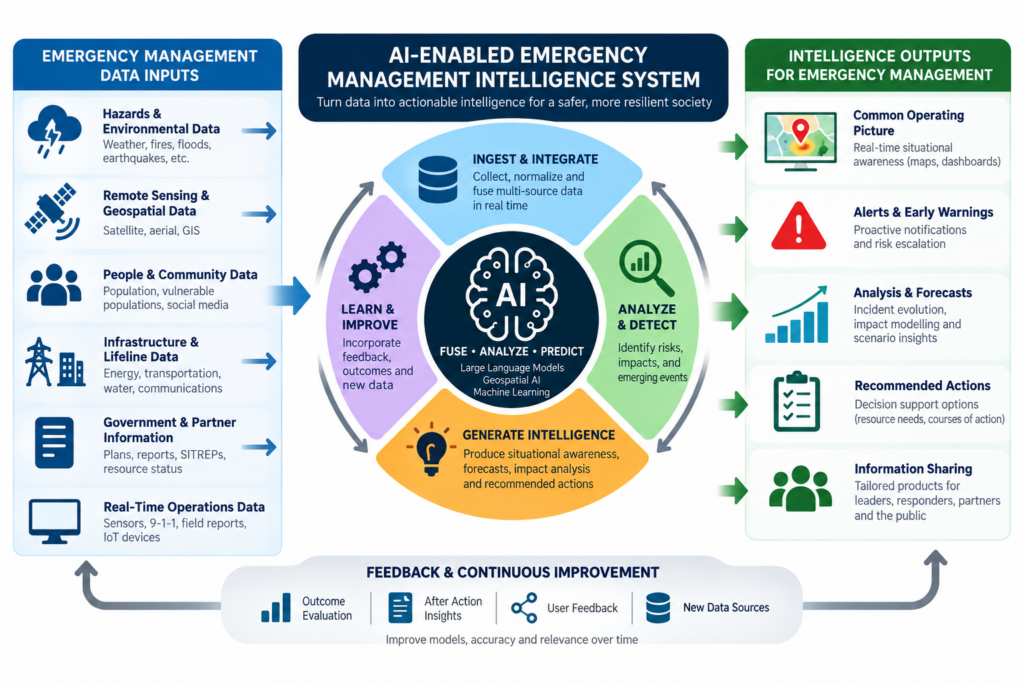
Now, imagine an AI-enabled emergency management intelligence capability that does more than collect and display information about current incidents. This evolving technology could also examine the relationships between hazards, vulnerabilities, infrastructure, organizations, decisions, and potential consequences.
For example, an AI-enabled emergency management intelligence system could identify that a prolonged heatwave is increasing electricity demand while simultaneously affecting water supplies, agricultural production, public health, and wildfire susceptibility.
Rather than simply reporting these conditions independently, the technology solution could help emergency managers understand how they might interact, which institutions have responsibilities, and where coordinated intervention could reduce systemic risk.
There is a potentially meaningful distinction between a common operating picture, which primarily describes what is happening, and a common understanding of systemic risk, which attempts to explain how evolving conditions could produce future consequences.
As climate change transforms the frequency, intensity, and interconnected consequences of natural hazards, emergency management must evolve beyond an event-centred operational discipline toward a systems-oriented practice grounded in an understanding of interdependence, continuous change, complex causation, and collective responsibility.
From managing events to understanding reality
What if emergency management could be organized primarily around the relationships that generate risk rather than the individual events that result from it?
The practical implication is that emergency management should seek to understand how conditions evolve and interact, not simply monitor whether a predefined emergency has occurred.
Where artificial intelligence changes the equation
Consider three levels of emergency management intelligence.
What is happening? (Incident reports · Weather alerts · Resource status)
2.Systemic Intelligence
Why is it happening and what else could happen? (Interdependencies · Cascading risks · Emerging vulnerabilities)
3.Anticipatory Intelligence
What actions could change the outcome? (Scenario simulation · Intervention analysis · Decision support)
Each level builds on the capabilities of the previous one. The third level is particularly interesting because it introduces the possibility of evaluating alternative futures.
AI could assist decision-makers in exploring questions such as:
- What cascading consequences might follow the failure of a particular electrical substation during a prolonged heatwave?
- Which communities are likely to experience disproportionate impacts from simultaneous flooding and infrastructure disruptions?
- Which interventions would most effectively reduce consequences across several interconnected sectors?
- How would changing one organization’s preparedness activities affect the vulnerability of other organizations?
Imagine an AI-enabled capability built around four complementary functions:
| Function | Practical capability |
| Observe | Integrate weather, infrastructure, environmental, social, and incident information |
| Understand | Identify relationships, dependencies, vulnerabilities, and emerging threats |
| Anticipate | Model plausible cascading consequences and alternative future scenarios |
| Advise | Recommend potential interventions, identify responsible organizations, and explain trade-offs |
This advanced solution could identify a developing flood risk, determine which critical infrastructure might be affected, identify the agencies with primary and supporting responsibilities, and generate potential courses of action for human review.
Current emergency management systems are generally designed around predefined information requirements. We decide what to monitor, what to measure, and what to report. But climate change can produce unexpected relationships that are not anticipated by those designing the system.
AI can help identify correlations, anomalies, and potential dependencies that were not part of the original analytical framework. We are closer than you might think to such a technology solution, but we need to approach emergency management from a more philosophically holistic perspective.